Candid vs Traditional Wedding Photography: Which Style Is Right for Your Wedding?
Somewhere between the sangeet and the vidaai, your wedding turns into a blur — and the only thing that holds those hours still afterwards is the photography. So when you sit down to choose between candid and traditional wedding photography, it can feel like you’re being asked to pick which memories matter more. You’re not. Here’s the short answer: traditional photography is posed, ritual-focused coverage — the family portraits, the stage shots, the formal frames your parents will hang on a wall. Candid wedding photography is unscripted storytelling — the stolen glance during the pheras, the laughter mid-haldi, the tears at the vidaai, caught exactly as they happen. Most couples don’t choose one over the other; they blend both, and that balance is what this guide is really about. Below, we’ll break down how the two styles differ, what candid coverage actually costs in 2026, and how to decide what your wedding needs — drawn from years of shooting weddings across Madhya Pradesh and beyond.
What’s the Difference Between Candid vs Traditional Wedding Photography?
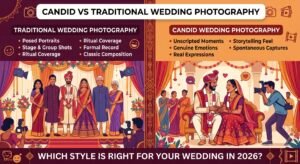
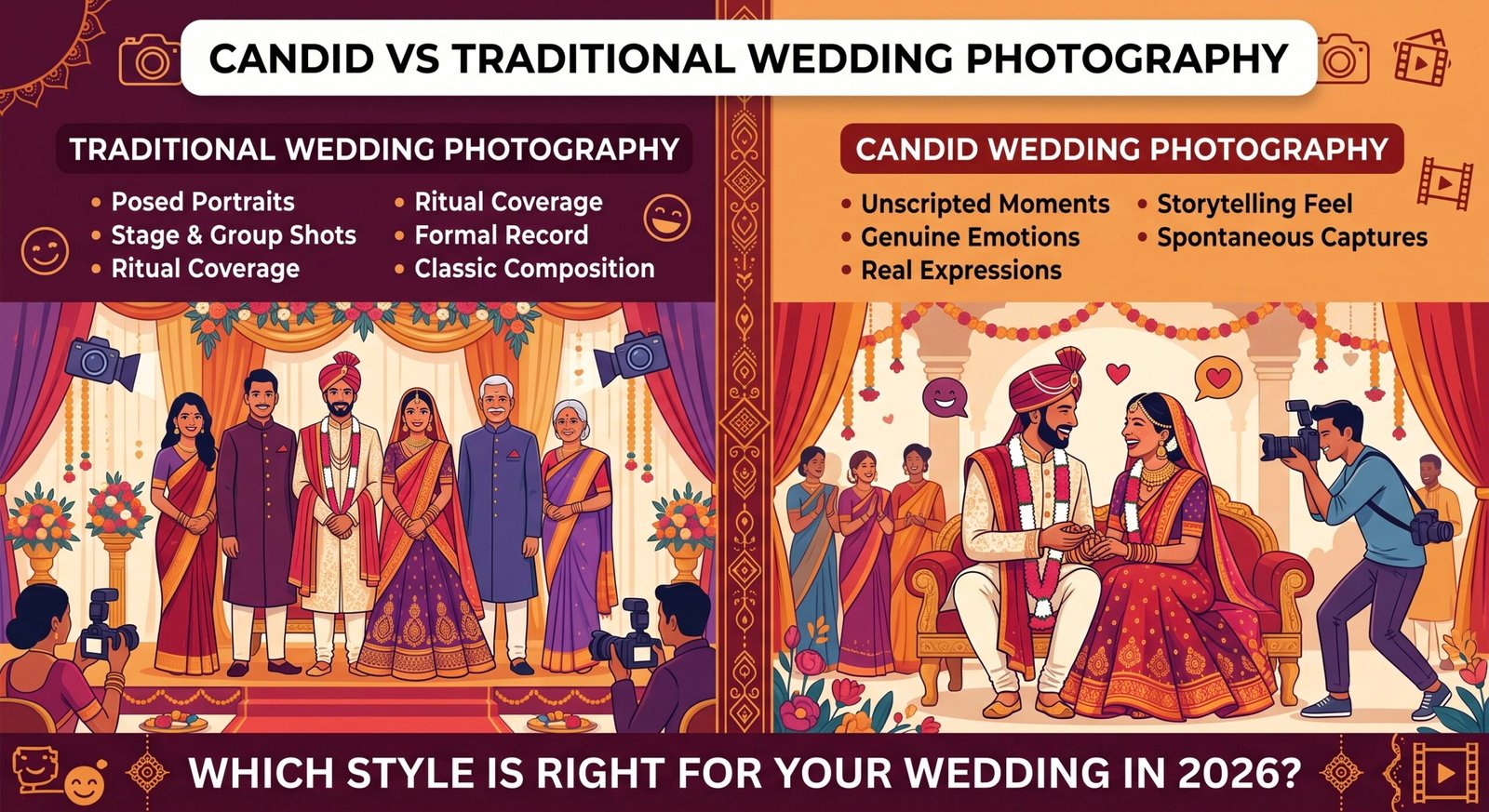
Traditional wedding photography is posed, ritual-focused coverage — family portraits, stage shots, and the formal frames built around your ceremonies. Candid wedding photography is unscripted storytelling — real emotions and reactions caught as they happen, without anyone asking you to pose. Traditional gives you a complete, organised record; candid gives you the feeling of the day. Most modern Indian weddings use both, in different measures.
Traditional photography: the posed, complete record
Traditional coverage is built around the rituals and the must-have combinations — you and your families on the stage, the garland exchange, the group portraits no one wants to be missing from. As photography studios describe it, traditional work is formal and ritual-focused, ensuring no key ceremony or family grouping gets missed. It’s the style your parents grew up with, and it still earns its place at every Indian wedding. The honest trade-off: used on its own, it can feel a little staged.
Candid photography: the unscripted story
Candid — or photojournalistic — photography is about the in-between. The haldi handful frozen mid-air, your grandmother quietly wiping a tear, the two of you laughing at something only you heard. Candid coverage is about catching these fleeting, unposed moments as they unfold, which is exactly why it needs an experienced eye and quick timing. It’s the difference between a photo you simply look at and a photo that drops you right back into the moment.
Is Candid Wedding Photography Worth the Extra Cost?
In most cases, yes — if emotional, story-driven images matter to you. Candid photography usually costs more than traditional because it demands longer shooting hours, more skill in anticipating moments, and far more intensive editing afterwards. Industry guides note that candid coverage often runs around 20–30% more than traditional for those reasons. If your priority is a posed family record on a tighter budget, traditional alone can still serve you well.
What you’re really paying the premium for is judgement. Candid photography is priced higher because it leans on creativity, timing, and advanced equipment — a candid shooter is reading a room and predicting a moment a half-second before it happens, then editing dozens of near-misses down to the few that sing.
There are weddings where traditional coverage alone is genuinely enough — an intimate ceremony, a tight budget, or families who simply want a clean, formal set of portraits. The trick is being honest with yourself about which frames you’ll return to most.
Many couples also find a middle path: a primarily candid team with one traditional shooter dedicated to family combinations, so the album feels alive and nobody important gets left out of the group portraits.
Pro Tip: You don’t have to go all-in on either. A sensible, common split is candid coverage for the emotional, high-energy events — haldi, mehendi, sangeet, vidaai — and a steady traditional hand for the main ceremony and family portraits.
How Much Does Candid Wedding Photography Cost in India in 2026?
In 2026, candid wedding photography in India typically ranges from about ₹60,000 to ₹1,50,000 per day, with experienced teams charging more. Across the country, couples spend around ₹1.5 lakh on average for wedding photography, though full packages span roughly ₹50,000 to ₹5 lakh-plus depending on scale. In tier-2 cities the average sits near ₹1.8 lakh, while smaller towns can start closer to ₹80,000. Your final number depends on events, team size, and deliverables.
Those ranges line up across the market: candid coverage commonly falls in the ₹60,000–₹1,50,000 per-day bracket, while national averages and the wider ₹50,000–₹5 lakh span reflect how much experience and scale move the needle.
What actually drives the price
The biggest lever is experience — a seasoned team is really selling reliability, creative direction, and a smoother day, not just camera time. Beyond that, price moves with the number of events, hours of coverage, team size, and deliverables like films, drone, and premium albums. More events and more footage mean more shooting and more editing, which is where costs climb. Location plays a part too — travel days, outstation stays, and venue permissions all add up, so a wedding spread across two cities will almost always cost more than a single-venue celebration.
Reading a quote properly
Watch for the extras that aren’t always in the base price — overtime, travel to distant venues, drone permissions, additional album copies, and GST. If you’re weighing packages and what’s included, our frequently asked questions page covers how we structure coverage and deliverables so there are no surprises.
Pro Tip: Ask every studio for two or three full wedding galleries, not just a highlight reel. Anyone can cut a stunning thirty-second edit; consistency across a whole, messy, real wedding day is what you’re actually hiring.
Do You Really Need Both Candid and Traditional Coverage?
For most Indian weddings, the honest answer is that the two styles complete each other rather than compete. Wedding-photography guides keep landing on the same conclusion — traditional coverage preserves the formal record while candid captures the natural essence of the day, and an album feels whole only when it has both. One without the other usually leaves a gap you’ll notice years later.
How the on-day experience shapes your candids
Here’s something couples underestimate: the best candid photos depend on how comfortable you feel. When the team blends in and you’re at ease, real emotion shows up on camera. Couples like Rimjhim and Harshal have told us the crew felt like family on their event — and that ease is precisely what lets unguarded, genuine moments happen in front of the lens. The same logic carries into your pre-wedding shoot, where there’s even more room to relax and simply be yourselves.
How to Choose the Right Style for Your Wedding in 2026
Start from how you want to remember the day, not from a style label. If you want to feel the day again, weight candid; if a formal family record matters most, make sure traditional is well covered; for most couples, a thoughtful blend wins. The clear 2026 direction is hybrid storytelling — candid images paired with cinematic film and social-ready reels, so couples walk away with both a timeless album and shareable highlights.
In our experience shooting across Madhya Pradesh and beyond, the couples happiest a year later are the ones who decided early what they wanted to feel — and briefed their photographer accordingly. If you’d like a sense of our approach before you decide, you can read more about how we see every wedding.
If you’re still torn, look at it from the future. A year from now, will you reach for a clean set of formal portraits, or will you want to feel the day again through unguarded moments? For most couples the honest answer is both — which is exactly why the blend, not the binary, is usually the right call.
Conclusion: Photograph the Day You’ll Want to Relive
Three things to hold onto. Traditional photography keeps the formal, ritual record. Candid photography keeps the feeling. And for most Indian weddings, a deliberate blend of the two gives you a complete story rather than half of one. Candid usually costs a little more — but for many couples, those unscripted frames are the ones they return to most, again and again. Decide early what you want to feel when you look back, and let that guide the balance between the two. If you’d like to talk through what that mix could look like for your wedding, we’d love to hear your story — reach out to us here.